An illuminated escape sign asks less of a battery in watts than almost any other safety device, yet its failure is measured in lives: in smoke, darkness and panic, a single running-man panel may be the only cue that tells occupants which way the protected stairwell lies. The sign must be legible at a distance defined by standards, in smoke, for the full rated duration. Paper A analyses that tiny, unforgiving load and its unusual self-test rhythm, and places it against ISO 7010 graphical symbols, EN 1838 escape lighting and IEC 60598-2-22 luminaire requirements.
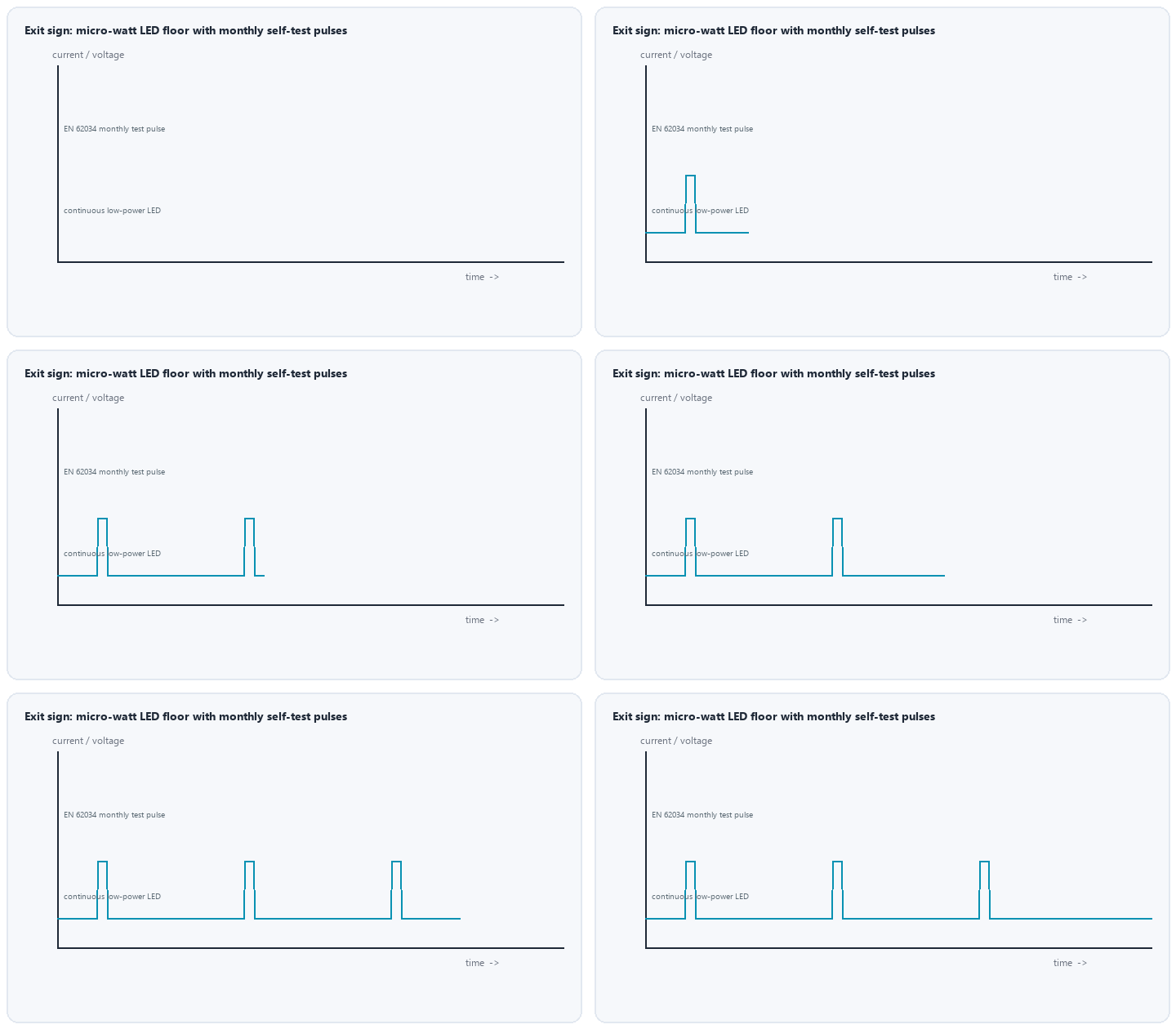
Modern escape signs use edge-lit or back-lit LED panels sized to make a pictogram meet its required surface luminance, not to light the floor. Electrical loads are consequently small - commonly of the order of 1-3 W maintained and often below 1.5 W in emergency - and remarkably constant, because the pictogram is either illuminated at fixed brightness or off. That flat profile is fundamentally different from an emergency luminaire, which must drive optics that illuminate a route: the sign battery is optimised for low, steady current over very long durations rather than for luminous flux. The animated trace below shows the near-flat micro-load floor interrupted only by the brief pulses of an automatic functional test per EN 62034 - monthly short tests and the annual full-duration test that together create the pack's only cycling.
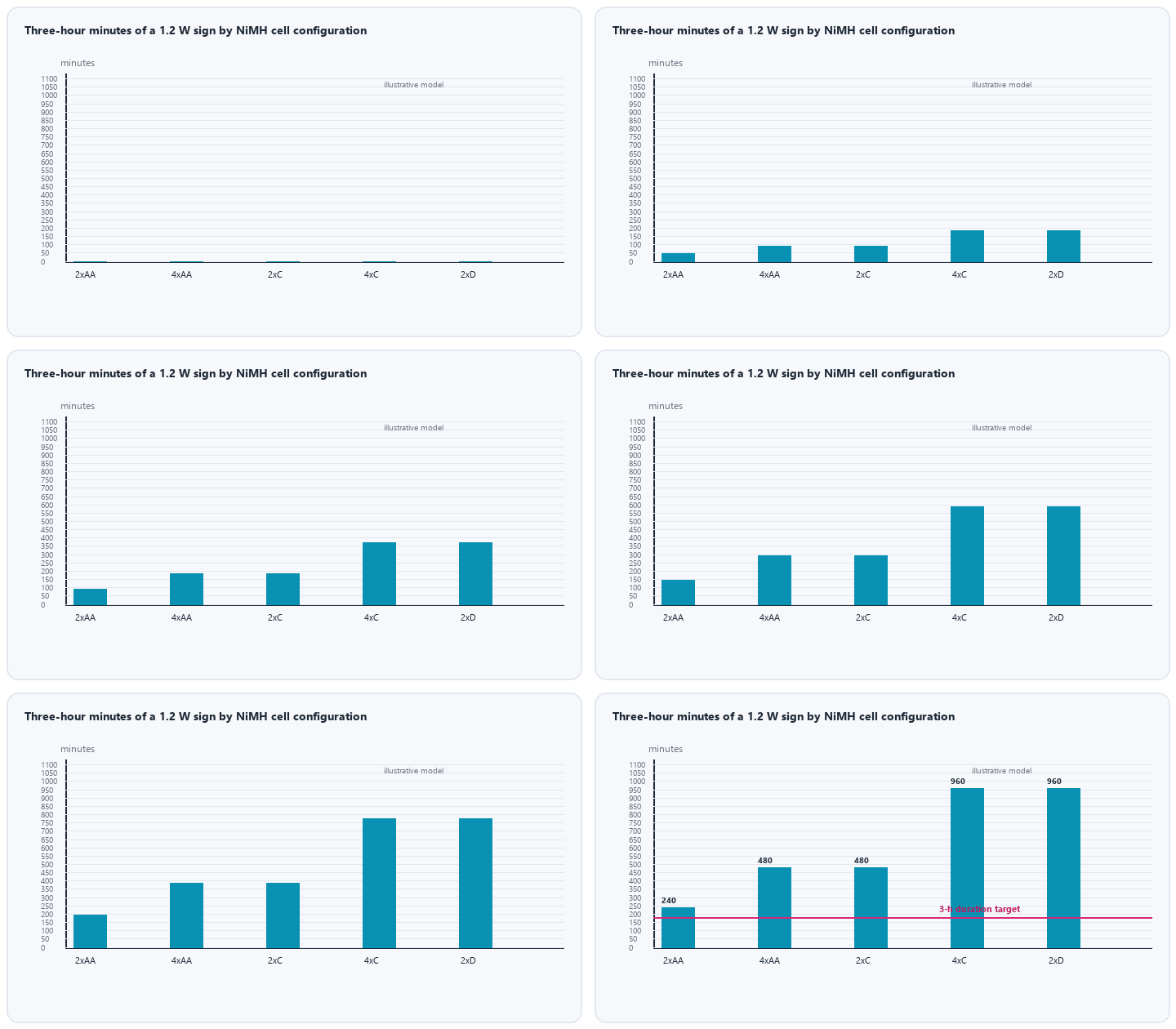
Rated durations for signs follow the same ladder as emergency lighting: one hour for ordinary evacuation, three hours where occupants require assistance or evacuation is delayed - hospitals, care homes, hotels, high-rise and assembly occupancies - with national codes setting the exact tier. Because the load is so small, three hours is reachable from compact NiMH strings of AA or C cells, which is why self-contained signs dominate corridors and stairwells where central systems are uneconomic. The animated chart below converts cell configurations into emergency minutes for a representative 1.2 W sign; the arithmetic is an illustrative model, but the lesson is general - at this power level the binding constraint is rarely energy, it is end-of-life voltage at the LED driver and the capacity lost to years of hot float.
EN 1838 and ISO 7010 approach the sign as an optical device. ISO 7010 defines the running-man exit symbol (reference E001) and directional arrows, with strict proportional geometry; EN 1838 sets minimum luminance of the safety colour, a luminance-contrast band between the symbol colour and the white panel, chromaticity ranges for safety green, and a recognition-distance relationship (the familiar rule that the effective viewing distance scales with pictogram height, approximately d = 200 h for an internally illuminated sign). Smoke attenuates contrast exponentially, so a sign designed at the photometric margin in clear air disappears first in a fire - and the LED current that sustains that luminance is set by the battery. A sagging battery at end of discharge does not merely dim the panel; it pushes the sign below its certified recognition distance precisely when smoke is thickest. Paper B develops this link from optical requirement to cell count.
A maintained sign stays lit day and night from the normal supply, switching to battery only on failure; a non-maintained sign is dark until emergency; many modern panels are switchable at installation. The battery sees the same readiness duty in both cases - years at full charge - but the thermal environment differs: a maintained sign's own LEDs and driver add a small continuous heat input to a ceiling enclosure that is already warm, so the pack must tolerate an ambient that can sit permanently above 35 °C. As with emergency luminaires, this makes temperature-compensated NiMH charge management the decisive design choice for reaching the declared service life, and it is the axis on which legacy NiCd - memory-prone and cadmium-bearing - is being designed out.
The sign's combination of minuscule steady load, multi-hour duration, years of float, compact enclosure and cadmium-free procurement policy favours NiMH strongly: small welded strings of AA or C cells deliver the energy with margin, aqueous chemistry removes any fire-risk concern above an escape route, absence of memory effect preserves duration through years of shallow self-tests, and low self-discharge grades keep the sign ready after long quiet periods. Paper B sizes the string from the optical rules; Paper C covers the luminance, contrast and viewing-distance validation that certifies the panel.
Weijiang Power manufactures compact NiMH strings for illuminated escape signs: matched AA and C cells for 1-3 h durations, float-charge profiles tuned to warm ceiling enclosures, and IEC 61951-2, IEC 62133-1 and UN 38.3 documentation. Send your sign's emergency wattage, rated duration, panel ambient and required end-of-life driver voltage and we will size a pack that holds certified luminance to the last minute of the rated event.


